|




|
|
|
 Local Access Pricing and the International Digital Divide Local Access Pricing and the International Digital Divide
To find out why electronic commerce isn't growing in some countries,
look no further than the price and structure of access
By Sam Paltridge
sam.paltridge@oecd.org
There is a growing international digital divide among countries
of the Organization for Economic Cooperation and Development (OECD).
This is contrary to a widespread view that in the area of development
of electronic commerce, the gaps between countries are narrowing.
The price of access to the Internet and the structure of this
pricing are key factors in explaining the relative development
of electronic commerce across the OECD area.
The Issues
The term digital divide refers to the gap between those with and those without access
to information and communication technologies, such as the technologies
needed to access the Internet and engage in electronic commerce.
Access to the information and communication resources that those
technologies enable is increasingly viewed as critical for economic
and social development. However, the digital divide could also
be said to exist between different countries, because the ability
of individuals to take advantage of the Internet varies significantly
among the member countries of the OECD.
The level and structure of pricing for Internet access are major
constraints facing both the users and the potential users. The
OECD has undertaken comparisons of Internet access pricing since
1995. The average price to access the Internet-including charges
for line rental, local calls, and ISP services-can be plotted
against the penetration of Internet hosts (figure 1). The data
reflect a strong correlation between the level of access pricing
and the rate of Internet development. They also bring home the
extent of the international digital divide-even within developed
economies.

Figure 1. Internet access pricing (1995-2000) and Internet hosts
per 1,000 inhabitants
The penetration rate of Internet hosts for the United States is
three times the average for the OECD, seven times that for the
European Union, and just over eight times that for Japan. However,
those figures reflect only partly the growing international digital
divide in terms of electronic commerce. For example, in March
2000, the United States added 3 times as many secure servers as
the rest of the OECD combined. This means that, on a per capita
basis, the United States added 10 times as many secure servers,
for that month, as the rest of the OECD.
At the same time, usage of the Internet in the United States and
in a small number of other countries with pricing structures favorable
to Internet access is far higher than counterparts in other OECD
countries, as reflected in average online times. This is encouraging
the development of new content and services-including multimedia
services supporting electronic commerce-at a much faster rate
than in countries where pricing is not favorable to electronic
commerce.
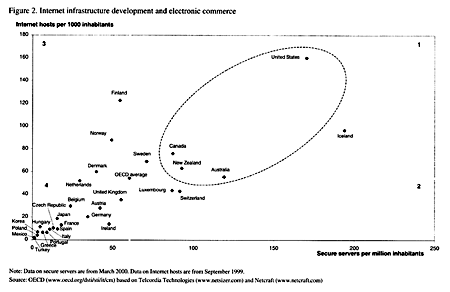
Figure 2. Internet infrastructure development and electronic commerce
When the penetration rate of Internet hosts is plotted against
that of secure servers, a clearer picture of the international
digital divide emerges (figure 2). Six countries are higher than
the OECD average on both scales. Each of them has had a history
of relatively inexpensive Internet access. Significantly, four
of the countries-Australia, Canada, New Zealand, and the United
States-have widespread availability of unmetered Internet access.
This suggests that pricing structure is also an important consideration
for assessing Internet and electronic commerce developments.
The Players
The major infrastructures currently used to access the Internet
at the local level are the public switched telecommunications
networks (PSTNs). Other networks are being developed, such as
those formerly dedicated to cable television, and PSTNs themselves
are being upgraded to provide high-speed options for Internet
access. PSTNs are also being modified to bring closer to the user
the point of separation between circuit-switched traffic and traffic
using the Internet protocol. This process ranges from telecommunication
carriers' installing modems at local exchanges to ISPs' colocating
equipment and using unbundled local loops. The different methods
are leading to different pricing structures for local telephony
calls and for Internet access via local loops.
Incumbent telecommunications carriers provide almost all of the
local lines used for Internet access-a consequence of more than
a century of legal monopolies. These operators have shown a marked
reluctance to offer a variety of pricing options, even though
there is patently increasing market demand for pricing innovation.
Simply put, the absence of competition in the local loop enables
dominant operators to disregard or delay meeting the changing
needs of business and individual users in relation to electronic
commerce. Nevertheless, direct intervention by governments to
impose pricing options that appear more favorable to electronic
commerce should be avoided, because it runs counter to the practice
of allowing telecommunication carriers to manage pricing structures.
For several decades, the OECD has advised governments to disengage
themselves from setting telecommunication prices. This is in line
with reforms that took the management and operation of telecommunication
carriers away from ministries of communication and regulatory
authorities. These reforms aimed to effect more efficient management
by telecommunication carriers and more transparent government
actions in regard to social objectives in the communications field.
For policy makers or regulators, the preferable response to the
challenges of the international digital divide is not to mandate
particular pricing structures-such as unmetered access-even if
the evidence is mounting that such structures are more appropriate
for electronic commerce. This would be a retrograde step because
it would return policy makers to setting telecommunication prices.
Instead, other policy options are available, including:
- High-level policy support for a greater range of pricing options,
particularly pricing favorable to the always-on capabilities necessary
to support electronic commerce
- Policy support for infrastructure competition
- Policy support for the unbundling of local loops
- Policy support for the competitive development of high-speed-access
options
These reforms would enable competition to play a greater role
in fostering the pricing innovation needed to support electronic
commerce and would address the international digital divide.
The Forums
In October 1998 the OECD held a Ministerial Conference in Ottawa,
Canada, at which it concluded that the growth of electronic commerce
relies on universal and affordable access to an information infrastructure.
Ministers agreed that to ensure a sustained long-term trend toward
lower costs, increased quality, and expanded access to information
infrastructures and services, effective competition in telecommunications
markets is required. The OECD provides an ongoing forum to discuss
the implementation of those objectives and provides analytic and
statistical resources for its 29 member countries.
A coalition of international business organizations-the Alliance
for Global Business (AGB)-also participated in Ottawa. The coalition
was composed of the Global Information Infrastructure Commission
(GIIC), the International Chamber of Commerce (ICC), the World
Information Technology and Services Alliance (WITSA), and the
International Telecommunication Users Group (INTUG). One of the
AGB's key recommendations to the Ottawa conference was that policies
that facilitate electronic commerce and the convergence of the
telecommunications, information technology, and multimedia industries
should be pursued in an open and competitive environment. These
business groups, particularly INTUG, continue to monitor communications
pricing and its relationship to policy and regulatory frameworks.
In March 2000 the cost of Internet access reached the attention
of presidents and prime ministers. The Lisbon Summit of the European
Council, a meeting of the leaders of European Union countries,
made it a priority to reduce the cost of Internet access at the
local level by the end of 2000. The summit was followed by a meeting
of European ministers in April 2000-under the Portuguese presidency
of the European Union-to coordinate policy in this area. This
meeting also had two other major focuses: (1) the difference between
Europe and the United States in the pricing of the networks that
underlie the Internet and (2) the need for reform.
The Prospects
All but 5 of the 29 OECD countries have liberalized their telecommunications
markets. Three of the 5 plan to do so in the next 18 months. Yet,
experience has shown that it takes time for local infrastructure
competition to develop. That's why the majority of OECD governments
are bringing forward plans to unbundle local loops in order to
encourage both pricing innovation and the more rapid deployment
of high-speed access via DSL. They are also taking initiatives
to bring additional players into the Internet access market via
new wireless technologies.
What the Private Sector Is Doing
At the local level-where competition is most advanced-the benefits
of pricing innovation are increasingly evident. Of the group of
countries that inherited a pricing structure most unsuitable to
electronic commerce, the United Kingdom is most advanced in addressing
these issues. One of the U.K.'s main advantages is that reform
is being built on nearly a decade of local infrastructure competition.
This means that many millions of households have a choice among
local access providers. In 2000, some of the first offers for
unmetered Internet access have been from new entrants such as
Telewest and NTL, both cable communications companies. Many ISPs
are also working with different telecommunication carriers in
the U.K. to offer unmetered access. Prompted by this competition,
British Telecom-the incumbent telecommunications carrier-is introducing
unmetered access as well. Other countries in which communication
companies have announced that unmetered access will be available
by mid-2000 include Germany, Hungary, Italy, South Korea, Sweden,
and Switzerland.
What You Can Do
In competitive markets, users are already voting with their accounts.
About the Author
Sam Paltridge is a communication analyst in the OECD's Division
of Information Computer and Communications Policy. His recent
work in communications is on infrastructure competition and on
Internet issues, including domain names, Webcasting, and traffic
exchange. He is a principal author of the 1995, 1997, and 1999
editions of the OECD's Communications Outlook. His most recent reports are on Internet Infrastructure Indicators
and leased-line pricing and electronic commerce. His written reports
can be freely downloaded from the OECD Web site. The views expressed
in this article are those of the author and may not necessarily
be those of the OECD and its member countries.
|
|